

Solid state relays (SSRs) are rugged, silent, and fast-switching — but they have one weakness: heat. Unlike electromechanical relays, SSRs dissipate power continuously whenever they're conducting. Get the thermal management wrong and you'll be replacing them prematurely, or worse, watching them fail mid-process.
Here's what you need to know to keep your SSRs running reliably.
This information is for general purposes only, please contact us on 03 9720 4522 or sales@practicalcontrol.com.au to discuss your specific requirements.
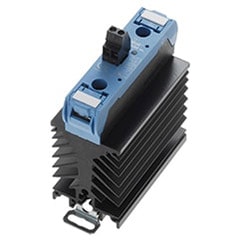
When an SSR switches a load, the internal semiconductor (typically a TRIAC or SCR) has a forward voltage drop of around 1–1.5 V. Multiply that by the load current and you get continuous power dissipation — entirely as heat.
At 25 A, that's roughly 25–37 W being generated inside a device smaller than the size of your fist. Without adequate heat removal, the junction temperature rises until the relay goes into thermal shutdown or fails outright.
The key parameter to understand is thermal resistance — usually expressed as θ (theta) in °C/W. Every material in the heat path has one: junction-to-case, case-to-heatsink, and heatsink-to-ambient. They add up. Your job is to keep the sum low enough that the junction stays within spec at your operating current.
Check the datasheet. Most SSRs specify a maximum current without heatsink — often 3–5 A for a 40 A rated relay. Below that threshold, the relay's own case can dissipate enough heat. Above it, you need external cooling.
As a general rule:
- Under ~5 A continuous: most DIN-rail SSRs are fine without a heatsink in a well-ventilated enclosure
- 5–15 A: a small aluminium heatsink is strongly advisable
- Above 15 A: a properly sized heatsink is non-negotiable; forced air cooling may also be required
Don't rely on the relay's current rating alone. SSR maximum current ratings only apply when they are mounted to a heatsink that can dissipate enough heat to allow the relay to achieve this current without over heating.
Heatsink thermal resistance (θ_hs) is rated in °C/W. To size it correctly:
1. Find the power dissipation at your load current (from the datasheet or calculate as V_drop × I_load)
2. Determine your maximum ambient temperature inside the enclosure
3. Find the SSR's maximum junction temperature (typically 100–125°C)
4. Work backwards: θ_total = (T_junction_max − T_ambient) / P_dissipated
Subtract the junction-to-case and case-to-heatsink resistances from θ_total to find the heatsink resistance you need.
Most SSR manufacturers publish heatsink recommendations for common current levels — use them as a starting point, then verify against your actual operating conditions. In the case of Celduc Relais, heatsink selection can be done easily and visually using their RMS load current vs power dissipation graph and heatsink dissipation curves. For more information see their white paper on heatsink selection using this method.
For panel or DIN-rail mounting, extruded aluminium heatsinks are the standard choice. If space is tight, black anodised heatsinks radiate heat more effectively than bare aluminium.
Check out our heatsinks for solid state relays here.
A heatsink only works if there's good thermal contact between the relay and the heatsink. Two common mistakes:
Skipping thermal interface material. The mating surfaces of an SSR and heatsink are never perfectly flat. Microscopic air gaps act as insulators. Always use thermal paste or a thermal pad — a thin, even layer of paste gives the best performance, while pads are cleaner and more repeatable.
Over- or under-torquing the mounting screws. Under-torquing leaves gaps; over-torquing can crack the relay's case. Follow the manufacturer's torque spec — typically 0.5–0.8 Nm for M4 screws.
Mount the SSR with the heatsink fins oriented vertically so natural convection can work. Horizontal fins are considerably less efficient. Avoid stacking relay / heatsink assemblies vertically to minimise the lower mounted units heating up the higher mounted ones.
SSR current ratings are always specified at a given ambient temperature. If your enclosure temperature is greater than the nominated current rating temperature then you need to derate.
Manufacturers typically provide derating curves. For example a relay rated 40 A at 40°C might only be usable at 25 A at 60°C ambient. Ignoring this is one of the most common causes of premature SSR failure.
If your enclosure runs hot, your options are:
- Upsize the SSR (choose a higher-rated relay for your actual load)
- Upsize the heatsink or add forced-air cooling
- Improve enclosure ventilation — sometimes the cheapest fix
This is the piece many people overlook. A well-sized heatsink on your SSR is only half the job — if that heat has nowhere to go, it just builds up inside the enclosure and raises the ambient temperature for everything in the panel.
Every watt your SSRs dissipate ends up as heat inside the cabinet. In a sealed enclosure on a hot day, internal temperatures can easily run 20–30°C above ambient. That directly eats into your derating margin and shortens the life of every component inside — not just the SSRs.
The most effective ways to manage enclosure temperature rise:
Ventilation with filtered openings. Louvred vents with dust filters at the bottom and top of the enclosure allow natural convection to move air through. This works well in clean environments and adds no ongoing maintenance burden beyond filter cleaning.
Forced-air ventilation with an enclosure fan. A thermostatically controlled fan-and-filter unit exhausts hot air from the top of the enclosure while drawing cooler air in at the bottom. This is the most cost-effective solution for most industrial installations and can keep internal temperatures within a few degrees of ambient.
Heat exchangers or air conditioners. For sealed enclosures in dirty or outdoor environments where you can't allow outside air in, a panel-mount heat exchanger or air conditioner transfers heat to the outside without air exchange. These are more expensive but necessary when contamination is a concern.
Mounting SSRs on an external heatsink through the enclosure wall. For high-current applications, this is worth serious consideration. The heatsink sits on the outside of the panel, so the bulk of the heat never enters the enclosure at all. It's cleaner thermally and keeps internal temperatures lower for all other components.
The bottom line: your heatsink sizing calculation uses ambient temperature as its baseline. If your enclosure ventilation is inadequate, that baseline is higher than you think — and your SSRs will run hotter than your calculations predict.
Natural convection heatsinks work well up to moderate loads, but there's a limit to what passive cooling can achieve in a confined space. If you're running SSRs at high currents, a small fan blowing directly across the heatsink fins can dramatically reduce thermal resistance.
A fan pushing air across the heatsink fins can cut effective thermal resistance by 50% or more compared to still air. This lets you use a smaller heatsink or run a higher current from the same relay — useful when panel space is at a premium. Just make sure the enclosure ventilation can handle the increased airflow, or you'll be moving hot air in circles.
Solid state relays are reliable components — but only when the thermal design is done properly. Taking the time to size the heatsink correctly and mount the relay well is cheap insurance against unexpected failures.
If you're unsure which SSR or heatsink is right for your application, contact us — we're happy to help spec it out.