This information is for general purposes only, please contact us on 03 9720 4522 or sales@practicalcontrol.com.au to discuss your specific requirements.
This is a subject that causes quite a bit of confusion. Semiconductor fuses are fast acting circuit elements specifically designed to protect solid state relays, thyristors (SCRs), diodes, mosfets and IGBTs. They are not designed to protect cables, heaters and other downstream equipment.
Circuit breakers or HRC fuses are not designed to and will not protect power semiconductors. Semiconductor protection fuses are normally the extremely fast acting class aR type which provides short circuit protection but not overload protection. Semiconductor protection fuses are usually combined with circuit breakers or fuses that provide overload protection to adequately protect both the circuit and the semiconductor elements.
When a semiconductor is subject to excessive current its junction heats up due to internal resistance. This heat is proportional to I2r where r is the internal resistance of the solid state relay.
In a fault condition with duration ∆t the solid state relay junction is exposed to I2r∆t of heating energy, where ∆t is the time it takes for the fuse to fully interrupt current. If the solid state relay’s maximum junction temperature is exceeded, typically 125°C, the device will be permanently damaged. Semiconductor junctions have very low thermal capacity and their temperature will rise very quickly with a rise in current.
The semiconductor protection fuse is designed to blow extremely quickly to limit the heating, or let-through energy that the solid state relay junction is exposed to.
The solid state relay or SCR manufacturer will specify a maximum I2t for a given device. The fuse selected must have a let through I2t less than that maximum.
For example, the Celduc SO865070 is a 50A solid state relay with an I2t of 2800A2s. A Bussmann 80FE fuse has an I2t of 900A2s at 415V AC so it will adequately protect this solid state relay.
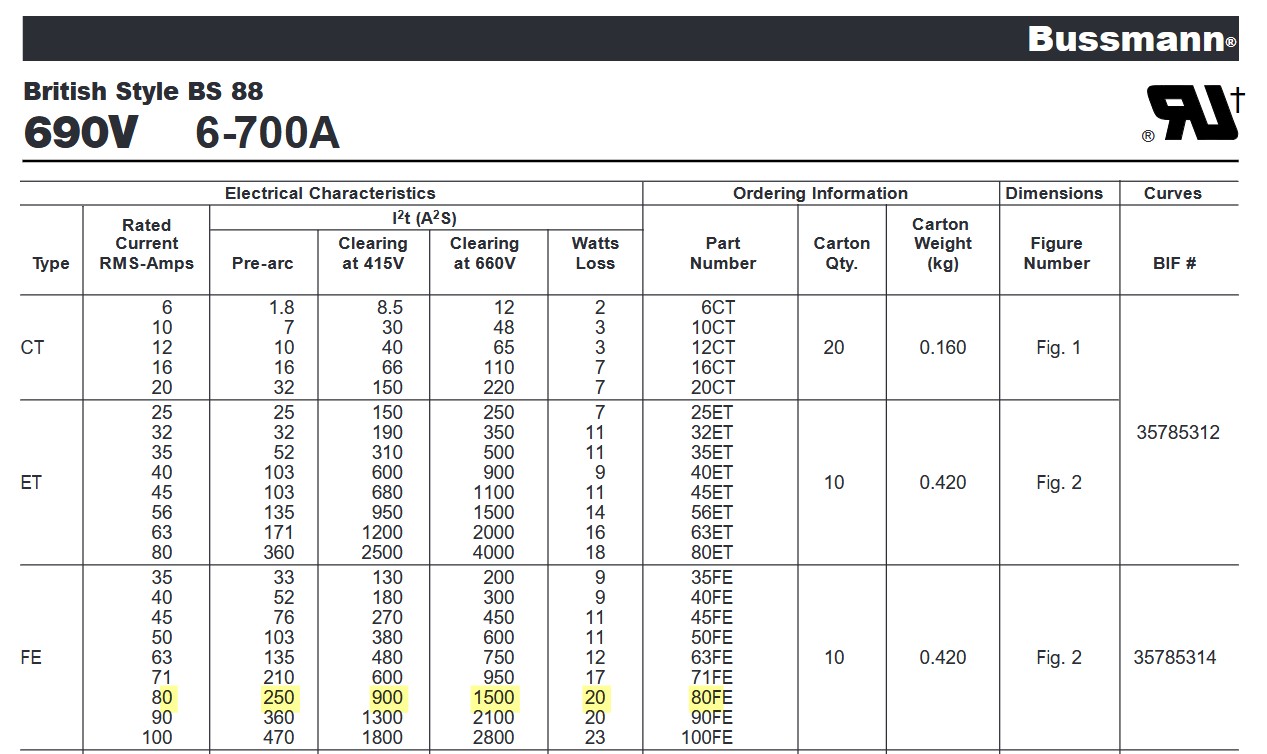
In the example above you might have noticed that the nominal current rating of the 80FE fuse is 80A, considerably higher than the 50A rated solid state relay. This seems counterintuitive but what is important for the protection of solid state relay is the I2t rating, not the nominal current rating of the fuse. In fact the 90A and 100A versions of this fuse also have low enough I2t values to adequately protect this device.
Protection of Cabling and Downstream Apparatus
Sticking with our example you might be asking yourself “how will this 80A rated semiconductor protection fuse protected my cables which have been sized for a 35A load?”. The answer is it won’t.
Another protection device, typically a circuit breaker with an appropriately low current rating, needs to be placed in series with the semiconductor protection fuse in order to protect cabling. In the case of a dead short the semiconductor protection fuse will blow first due to its high speed. In the case of a partial short where the circuit draws, say 50A, the semiconductor fuse would remain intact and our 40A breaker would trip, protecting our cabling.
Circuit breakers by themselves will not protect power semiconductors, they are too slow acting. Slow action corresponds to a high let-through energy.
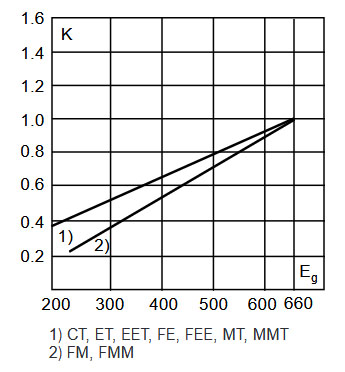
The semiconductor must be rated for the maximum voltage it will be exposed to. In addition the supply voltage effects the I2t of the fuse. This is because the higher the supply voltage the greater the internal arcing within the fuse which increases the let-through energy or I2t.
Fuse manufacturers will provide a graph that gives a K factor, for voltages lower than the rated maximum, to apply to the fuse maximum voltage I2t.